
Battery and electronic device disposal
Used Battery / Used Battery Return

Batteries must not be disposed of with household waste.
You are legally required to dispose of waste batteries and accumulators, hereafter referred to as waste batteries, separately from other waste streams, including mixed municipal waste, so that they can be properly treated. Batteries and rechargeable batteries contain both harmful substances and valuable materials that can be recycled. Proper disposal helps prevent harmful substances from entering the environment, avoids negative effects on the environment and human health, and allows important resources to be reused.
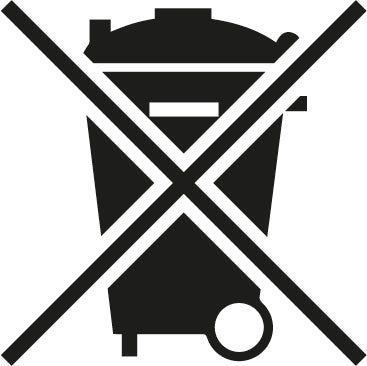
The crossed-out wheeled bin symbol means that batteries must be collected and disposed of separately from household waste.
Batteries containing hazardous substances may also display the following symbols beneath the crossed-out wheeled bin:
Pb = battery contains more than 0.004 percent lead
Cd = battery contains more than 0.002 percent cadmium
Hg = battery contains more than 0.0005 percent mercury
After use, waste batteries and accumulators can be returned free of charge to a public collection point or to any retailer that sells batteries and rechargeable batteries.
You may also return your batteries and rechargeable batteries to us free of charge, provided we stock or have stocked batteries of the same category:
Bermüller & Co. GmbH
Rotterdamer Straße 7
90451 Nuremberg
Germany
Please help prevent waste, for example by choosing rechargeable batteries and storing them in a cool, dry place. Handle waste batteries with care, especially lithium batteries, as they may catch fire if stored incorrectly, subjected to impact, damaged or overheated. The risk of fire is particularly high if a battery is severely damaged mechanically. Please take defective batteries to the hazardous waste collection point at your local recycling centre.
Further information, including guidance on the proper storage and transport of batteries and on the costs borne by manufacturers for battery collection and treatment, is available from the battery take-back information service.
Disposal Information for Waste Electrical and Electronic Equipment
Waste electrical and electronic equipment must not be disposed of with household waste.

As a distributor of electrical and electronic equipment, we are required to provide you with the following information:
All electrical and electronic equipment that can be used in private households is marked with the crossed-out wheeled bin symbol shown below.

The crossed-out wheeled bin symbol means that electrical and electronic equipment must not be disposed of with household waste. Instead, waste electrical and electronic equipment must be collected separately from unsorted municipal waste. Before handing in an old appliance at a collection point, you must remove any waste batteries and accumulators that are not enclosed in the appliance, as well as any lamps that can be removed without damaging the appliance.
Please handle waste batteries with care, particularly batteries containing lithium, as they may catch fire if stored incorrectly, subjected to impact, damaged or overheated. This may create a fire or explosion risk. For lithium-containing batteries, cover the terminals before handing them in to prevent short circuits.
You are responsible for deleting any personal data stored on appliances you are disposing of.
Under Section 17, paragraphs 1 and 2 of the German Electrical and Electronic Equipment Act (ElektroG), we are required to take back waste electrical and electronic equipment in accordance with the following rules. We meet this obligation as follows:
When we supply a new electrical or electronic appliance to an end user, we will take back, free of charge, an old appliance of the same type that performs essentially the same functions. The old appliance can be returned at the place of delivery or in its immediate vicinity. The place of delivery also includes the end user’s private household if the new appliance is delivered there.
Free collection from the household is limited to equipment in Category 1, heat exchange equipment; Category 2, screens, monitors and equipment with screens larger than 100 cm²; and Category 4, equipment with at least one external dimension greater than 50 cm.
For equipment in Category 3, lamps; Category 5, small equipment; and Category 6, small IT and telecommunications equipment, we provide suitable return options within a reasonable distance. You can find a nearby return point through the take-e-back service. An overview of the equipment covered by each category is available from the Stiftung ear device classification information.
On request, we will also take back free of charge old appliances that are no larger than 25 cm in any external dimension through suitable return options within a reasonable distance. This take-back service is not conditional on purchasing electrical or electronic equipment and is limited to three old appliances per type of equipment. You can find a nearby return point through the take-e-back service.
When returning an old appliance by post, please ensure it is properly packaged to prevent it from breaking. Mechanical compression or breakage must be avoided. We may refuse to accept old appliances if contamination poses a risk to human health or safety.
Private households may also return their waste electrical and electronic equipment free of charge to municipal collection points. An online directory of collection and take-back points is available from the German national register for waste electrical equipment.
Further information is available from the e-waste disposal information service:https://e-schrott-entsorgen.org
